
When Did Fashion Get So… Safe?
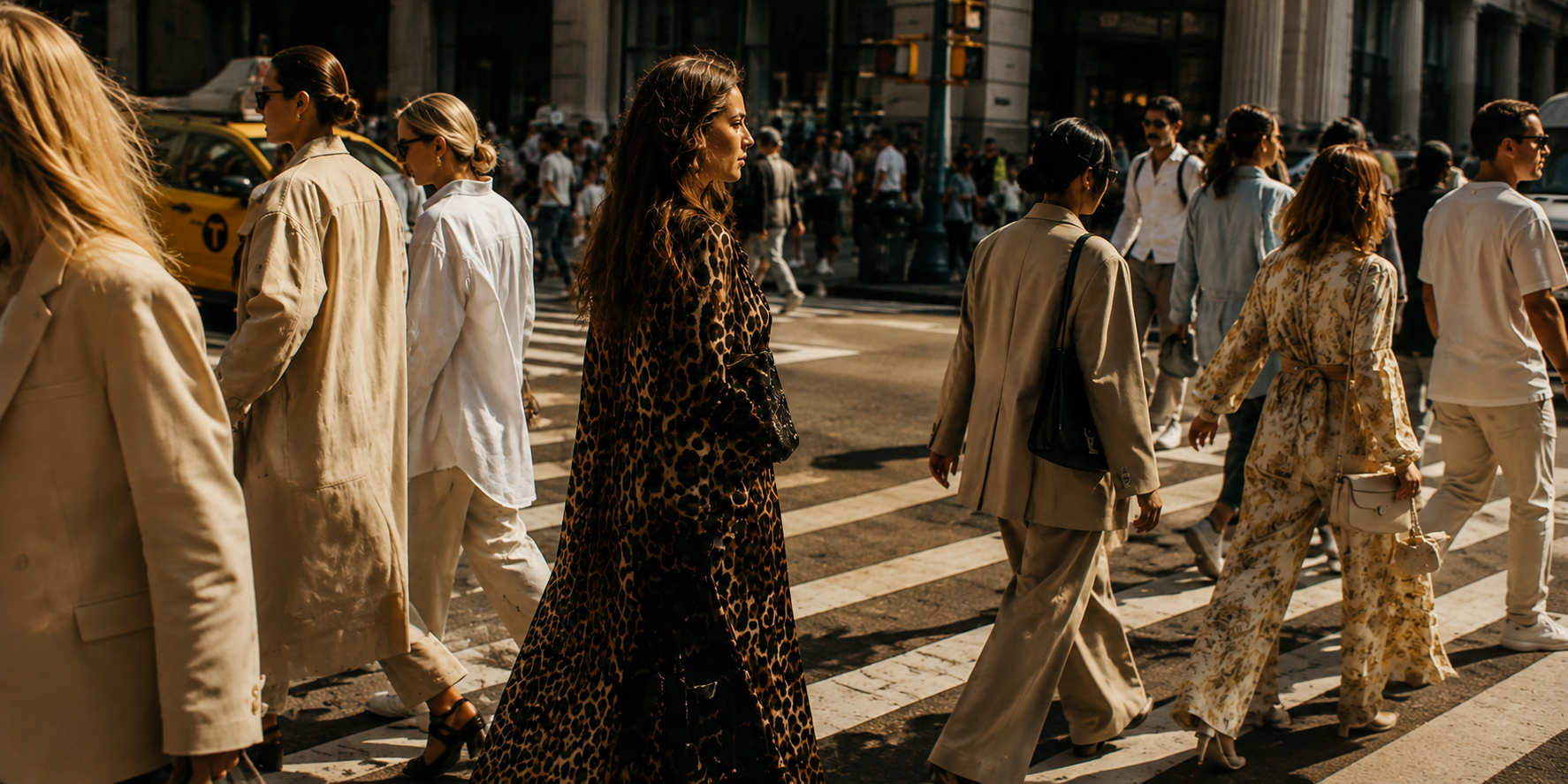
After years of quiet luxury, clean girls and perfectly curated neutrals, fashion seems ready to have a personality again.
Isn’t it ironic that influencers are now influencing us to take social media detoxes?
Well, apparently, I was influenced.
I had reached algorithm burnout. I was giving my time away to an influencer showing me her latest Zara haul, another DIML, another morning routine, another video I hadn't searched for but somehow watched until the end.
At some point, I decided it was enough. I needed a break.
And when I started putting my phone away, something funny happened: I started looking at everyone else.
I noticed the girl journaling alone at a café. Someone reading while waiting for a friend. A woman knitting on the metro.
Maybe they had always been there and I had simply been too busy looking at my phone to notice.
That made me wonder…
Are we getting tired of the dopamine-fuelled content era?
The brainrot afterlife
Call it voyeuristic curiosity, escapism, or good old-fashioned nosiness, but social media has given us the ability to endlessly scroll through strangers’ lives: what they do first thing in the morning, what they eat, what they buy, where they go.
Somewhere along the way, watching turned into aspiring.
We weren’t just peeking into other people’s lives anymore; we were escaping our own — our jobs, our housing situations, our relationships — and slowly immersing ourselves in a world of aspirational content, desiring the lives of people we didn’t even know.
TikTok users spend around 1 hour and 37 minutes a day on the platform. That’s roughly 48.5 hours a month.
The algorithmic loop had us exactly where it wanted us.
But now, audiences — and particularly Gen Z — are showing signs of fatigue.
Not necessarily because we’ve suddenly stopped caring about other people’s lives. We are nosy, after all.
But perhaps the endless stream of hauls, DIMLs, morning routines and perfectly packaged aspiration isn’t hitting quite like it used to.
We’re developing an appetite for something slower. Deeper. More deliberate.
WPP Media’s Goat Agency has a name for it: “intentional content consumption.”
Think of it as a post-pandemic correction of sorts.
After years of handing the algorithm the reins, we’re starting to want them back. To decide what we watch. Who we listen to. What deserves twenty minutes, an hour, or perhaps none of our time at all.
We don’t necessarily want less content.
We want more control over what we’re feeding our brains.
We’re becoming more selective about what deserves our attention.
Save the drama for your mama… content isn’t dead. It’s noise we’re ditching
Relax. Your feed isn’t dying.
For years, we wanted it all.
More entertainment. More creators. More restaurant recommendations. More things to discover. More access to… absolutely everything.
And, well…
We got it.
Which is where consumer behaviour gets interesting.
Because when access becomes infinite, abundance can stop feeling exciting and start feeling overwhelming.
Suddenly, more isn't necessarily better.
We want someone to filter it.
To tell us what is actually worth watching. Worth reading. Worth listening to. Worth our time.
We want curation.
But it isn't only how much content we're consuming that seems to be changing. It's what we're willing to give our attention to in the first place.
For a generation supposedly suffering from destroyed attention spans, we seem remarkably willing to sit through a three-hour podcast.
Substack has turned the old-school newsletter into something people actually pay to read. YouTube deep dives can require the commitment of a minor feature film. And niche creators are building audiences around knowing an unreasonable amount about one very specific thing.
Maybe we don't have an attention problem.
Maybe we have an attention-worthiness problem.
We still want content. We just increasingly want something back from it.
A new idea. A recommendation we actually trust. Something to learn. Something worth saving rather than forgetting before the next video has even loaded.
And then, somewhere in our search for more intentional ways to spend our attention, something even stranger happened.
We started looking beyond content altogether.
Hold on — and my mum will probably read this next part with tears in her eyes — but apparently there is a whole world outside our screens.
And suddenly, we seem rather interested in it.
Is analogue life finally clocking to us?
Logging off is becoming a new kind of status symbol.
Forget the FOMO, the viral restaurant you haven't tried or that sold-out T-shirt everyone somehow discovered through the same Instagram ad.
Apparently, missing out is becoming cool.
WGSN has a name for part of this shift: digital privilege — the ability to disconnect without losing professional or social relevance.
Or, as they rather perfectly put it: “Logging off is the new luxury logo.”
And the desire to disconnect seems to be growing. According to research from The Future Laboratory, 57% of respondents said they were seeking a less-connected lifestyle. Meanwhile, Pinterest searches among Gen Z for the “analogue aesthetic” increased 260% between January 2025 and January 2026.
And suddenly, all those wonderfully offline hobbies start to make a little more sense.
We are embracing our wonky crochet skills. Cooking from scratch. Attempting to master the inner mixologist we apparently had all along. Picking up analogue cameras. Buying physical books we could technically read on a screen.
We are even buying alarm clocks so that a phone screen isn't the first thing we touch in the morning.
But perhaps what makes all of this so appealing isn't simply that it's offline.
It's that analogue life has boundaries.
A roll of film has a last photo.
A book has a final page.
A knitted bag eventually becomes a knitted bag.
You make the cocktail. You drink it. It's over.
Compare that with the feed.
There is no final TikTok. No last Instagram Story. No satisfying moment when the algorithm says, That's enough for today. You've completed the internet.
Maybe that's what we're really looking for when we romanticise analogue life: finite experiences in an infinite world.
Something that actually ends.
The satisfaction of finishing the knitted bag you made. The last photograph on a roll of film. Closing a book with a slightly melancholic sigh.
We crave endings.
And perhaps analogue life is becoming aspirational precisely because digital life has become the default.
Brands finally figured out the internet. So we logged off.
How frustrating must it be for brands?
For years, they mastered the skill of building experiences around being photographed and shared.
The jaw-dropping Instagram wall at that pop-up you waited three hours to enter. The impeccable product launch. The brand trip designed to make everyone who wasn't invited deeply aware of the fact.
And just when they got the hang of it, we suddenly decide we'd rather experience things offline.
How nice of us.
But brands, of course, are adapting.
After years of designing experiences for the camera, they seem to be rediscovering the consumer attached to it.
Look at Rare Beauty.
The brand launched Rare Offline, a series of phone-free, no-photo dinners in New York and Paris where guests were encouraged to actually be present, connect with the community and experience the brand away from their screens.
Think about how strange that would have sounded a few years ago.
A brand event where guests are specifically asked not to post?
And it isn't only about putting phones away.
Brands are also leaning harder into experiences that simply cannot be replicated through a screen.
Rare Beauty installed an interactive giant rollerball billboard in New York that allowed passers-by to physically experience its new fragrance.
Tower 28 went one step further and created a Manhattan billboard with a button that literally sprayed its SOS facial spray onto passers-by.
You can watch someone smell a perfume on TikTok.
But you still can't smell it yourself.
And perhaps that's what makes sensory marketing particularly interesting right now.
After years of trying to translate the physical world into content, brands are finding value in the things a screen still can't give us.
Smell it. Touch it. Taste it. Be there.
So, is social media dying?
Not quite.
After all, I was influenced by social media to take a social media detox.
We discover analogue hobbies on TikTok. We search for the “analogue aesthetic” on Pinterest. We find books through creators, subscribe to Substacks we probably first heard about on Instagram.
We are so online that even logging off has become content.
And maybe that's the irony of all of this.
We're not abandoning the internet. We're just becoming more conscious of how much of ourselves we're willing to give it.
Because perhaps the shift isn't really from TikTok to books, or from digital to analogue, or from brainrot to suddenly becoming intellectuals who spend Sunday afternoons reading philosophy and developing suspiciously good crochet skills.
It's from passive to chosen.
So, is having an attention span becoming a status symbol?
Maybe.
But I think the real status symbol is becoming something slightly different.
Having somewhere better to put it.
